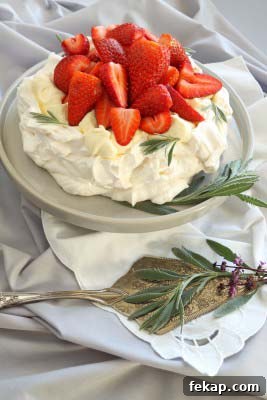
Pavlova – Meringue Cake (Naturally Gluten Free)
Serves: 6–8
Ingredients
For the Meringue
- 2 cups fine sugar (or granulated sugar processed briefly in a food processor)
- 2 tablespoons cornstarch (or potato starch)
- 2 teaspoons white vinegar
- 2 1/2 teaspoons pure vanilla extract
- 8 egg whites, at room temperature
Topping Options
- Bavarian cream: Use a prepared gluten-free Bavarian or pastry cream, chilled overnight.
- Sweetened whipped cream: Use your preferred recipe for sweetened whipped cream (regular or dairy-free).
- Yogurt whipped topping: 1 cup heavy cream and 1/2 cup plain gluten-free yogurt, whipped together until stiff peaks form.
Fruit
- Strawberries, halved
- Kiwi, peeled and sliced (or berries, optional)
Instructions
To Make the Meringue
- Preheat the oven to 350°F (177°C).
- In a small bowl whisk together the cornstarch, vinegar, and vanilla extract; set aside.
- In a clean mixer bowl, combine the sugar and egg whites. Beat on low just until the sugar dissolves, then increase to high and beat until soft peaks form.
- Slowly add the cornstarch mixture and continue beating on high until very stiff, glossy peaks form, about 4–6 minutes total.
- Line a baking sheet with parchment paper. Place a 9-inch round plate on the parchment, trace the circle with a pencil, then flip the parchment so the pencil mark is underneath.
- Spoon the meringue onto the center of the traced circle and spread with a rubber spatula to fill the circle, smoothing the top and sides. You may create decorative peaks if you like; they may brown slightly during baking but this is fine if you plan to cover the sides with cream.
- Put the baking sheet in the oven, immediately reduce the temperature to 215°F (102°C), and bake for 1 hour 15 minutes. The initial higher heat helps set the meringue structure before the low-and-slow drying phase.
- Turn the oven off and leave the meringue inside to cool slowly for 3–4 hours (or overnight). Slow cooling prevents cracking and makes the pavlova easier to handle.
- Carefully remove the parchment from the bottom of the pavlova. Use a pizza peel or two large spatulas to transfer the meringue to a serving plate.
To Make the Yogurt Whipped Topping
- Chill a metal mixing bowl if possible. Beat the heavy cream and yogurt on high until stiff peaks form.
- Spread the whipped mixture over the cooled pavlova, smoothing or creating soft peaks with a spatula.
- Top with halved strawberries, sliced kiwi, or a selection of fresh berries. Slice and serve immediately—pavlova is best the same day it’s dressed.
Notes & Tips
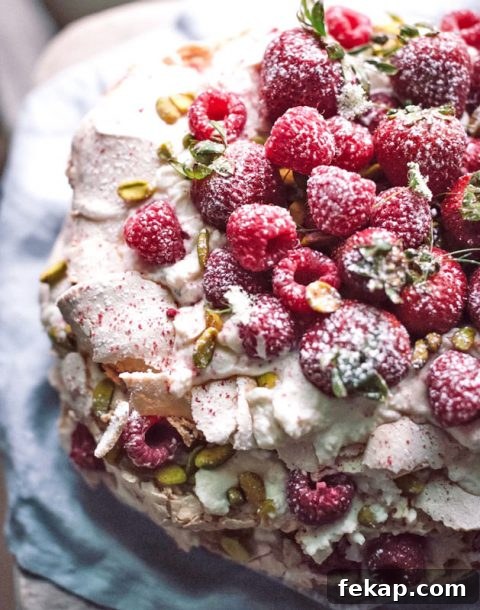
Pavlova takes a little practice to shape attractively. If your first attempt cracks or looks uneven, simply cover the sides with whipped cream and decorate the top with fruit.
For a different flavor, fold a few tablespoons of cooled lemon curd into the sweetened whipped cream. To make a simple lemon curd: whisk together 1 large egg, the juice and zest of 1 lemon, and 1–2 tablespoons unsalted butter in a small saucepan over low heat; cook, stirring, until thickened (about 10–15 minutes). Cool completely before folding into cream; add powdered sugar to taste.
If you prefer Bavarian or pastry cream as a topping, prepare and chill it thoroughly before assembling the pavlova so the filling keeps its structure on the meringue base.